
So you’ve been hearing more and more about electric trucks. Maybe you’ve spotted one hauling a trailer up the Malahat, or noticed a neighbour plugging theirs in overnight. And somewhere in the back of your mind, a question keeps popping up: could that work for me?
My name is Julian Sale. I’ve been buying, selling, trading, and working on electric vehicles for 16 years. At Motorize, we help families and businesses all across Greater Victoria, Sidney, and the Saanich Peninsula make sense of the EV market — and lately, electric trucks are the hottest topic in the shop.
So I sat down with Jenny from our team to answer every question I hear — the ones about towing, charging, cost, road trips, and yes, which trucks I’d actually buy with my own money. Let’s get into it.
What Exactly Is an “Electric Truck”? More Than You Think
Before anything else, let’s clear this up. When people hear “electric truck,” they often picture a massive commercial semi — and yes, those exist. But the electric truck market today covers a huge range, from small utility vehicles right up to full-size consumer pickup trucks.
On Vancouver Island right now, you’ll find:
- Ford F-150 Lightning — one of the most popular full-size EV pickups in the used market
- Chevy Silverado EV and GMC Hummer EV — massive batteries, serious capability
- Tesla Cybertruck — polarizing, but genuinely tough
- Rivian R1T — a well-built, purpose-designed EV pickup that’s starting to appear in the used market
- Cold Star refrigerated freight trucks — you’ve probably seen these on island roads; they used to run on natural gas and have now moved to fully electric
- Mercedes electric vans — available in a variety of sizes, upwards of one ton
- Ford Transit Connect EVs — shorter range, but really practical for plumbers, cabinet makers, and delivery people
- BrightDrop electric vans — built in Canada by General Motors, these were specifically designed for commercial delivery and are a genuinely forward-thinking piece of technology
That’s not even mentioning school buses and municipal service vehicles. The point is: there are more fully electric trucks operating on Vancouver Island today than most people realize.
Part One: Why Should You Even Consider an Electric Truck?
The Cost Difference Is a Game Changer
Here’s the thing most people don’t fully appreciate until they do the math.
The Chevy Silverado and Hummer EV both have battery packs over 200 kilowatt hours — think of that like a really, really big fuel tank. To fill one of those at a DC fast charge station costs maybe $100 in the most expensive cases. Compare that to filling a gas truck with the same range: you’re looking at $250 to $300.
Now here’s where it gets really interesting. If you’re using your truck around the city, just day-to-day driving, and you have a truck with a range of around 300 kilometres — you might only pay $15 to $20 to fill it up at home on your regular electrical system.
That means 300 kilometres for $20, instead of $200 or more. That is a super game changer for anyone who uses a truck for recreation, work, or deliveries.
And that’s before you even consider the newer safety and comfort features — automatic collision avoidance, lane keep assist, and all the stuff that older gas trucks simply don’t have.
Part Two: Can an Electric Truck Actually Do Real Truck Work?
Here’s the Honest Truth About What Gas Trucks Actually Do
This one always sparks a great conversation. The biggest misconception I hear is that electric trucks can’t do real truck work. But check this out: if you drive around lower Vancouver Island and look at who’s actually behind the wheel of pickup trucks at any given intersection… it’s mostly single drivers with nothing in the truck bed and nothing on the hitch.
The reality is, most gas truck owners aren’t doing very much “truck stuff” most of the time. So the real question isn’t “can an electric truck keep up?” — it’s “what do you actually need your truck to do?”
That’s where we start. We look at your lifestyle — how many people need to fit, what you want to tow, how far you drive, where you work — and we match you with the right truck for those needs.
Can Electric Trucks Tow? Absolutely.
Yes, you can tow with everything from a Nissan Leaf to an F-150 Lightning. When you’re towing, you’re going to use more energy per kilometre — but that’s exactly the same rule that applies to gas or diesel. A heavily loaded gas truck burns way more fuel than one running empty. The only difference with an electric truck is that it still costs less.
For serious towing trip planning, there’s a really useful tool called A Better Route Planner(ABRP) — available as an app or on desktop. You enter your vehicle, your load weight, and your route, and it tells you exactly what range to expect and where to charge. It takes a lot of the guesswork out of it.
The Bonus Nobody Talks About: On-Board Power
Here’s something that really surprises people — especially tradespeople. Electric trucks like the F-150 Lightning, the Rivian R1T, and the Silverado EV can actually power your tools and equipment directly from the truck’s battery.
That means 120-volt and 240-volt power, available wherever your truck goes. You can run a compressor on a job site in the middle of nowhere. You can charge cordless tools, run a coffee maker — basically anything you’d normally need a gas generator for.
So not only do EV trucks eliminate the gas generator on the job site, they free up cargo space and do it for pennies on the dollar compared to running a traditional internal combustion setup. Pretty remarkable when you think about it.
Part Three: The One Thing Electric Trucks Do Better Than Gas — Uphill Towing
Now, this is my favourite one.
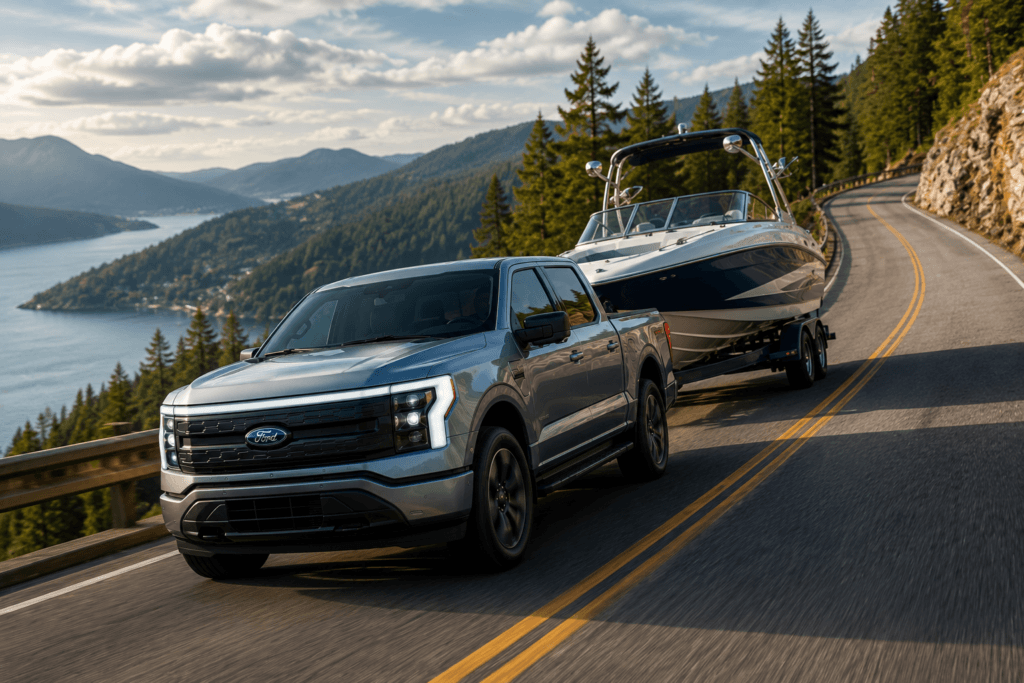
Electric motors produce instant torque — that’s the twisting force that actually moves your vehicle and your load. There’s no hunting for gears, no waiting for an RPM sweet spot. An electric motor just delivers power immediately, smoothly, and consistently.
A modern gas or diesel truck might have seven, eight, even ten gears in the transmission. That’s a lot of moving parts, a lot of friction losses, and a lot of extra mass — all just to help the engine deal with the towing job.
Electric trucks don’t have transmissions. They have a simple gear reduction with about 95% fewer moving parts. The result? Going uphill with a trailer is just… better. Smoother. More controlled. Way less stressful.
And going downhill is where it gets really clever. With a gas truck towing a heavy load down a hill, you’re riding the brakes to slow down the mass — and that wears out brake components fast. With an electric truck, regenerative braking kicks in — think of it as the truck recycling its energy. Instead of burning off speed as heat through your brake pads, the motor captures that energy and puts it back in the battery.
You can realistically recover 30 to 40% of the energy you spent climbing back when you come down the other side. Gas trucks just burn fuel going up and waste it going down. Electric trucks actually give some of it back. That’s a fundamental difference.
Part Four: Charging Your Electric Truck at Home
Do You Need to Upgrade Your Electrical Panel?
Great question — and the honest answer is: it depends on how far you drive.
Here’s the basic math. If you’re driving 30 to 50 kilometres a day, you can realistically recover all of that overnight by simply plugging your truck into a regular 120-volt wall outlet using the trickle charger that comes with the vehicle. That draws about 12 amps and gives you roughly 8 to 10 kilometres of range per hour plugged in. Plug in for 10 hours, get about 80 km back — easy.
But if you’re covering 150 kilometres a day, towing regularly, or running the truck commercially, a regular outlet won’t keep up. In that case, a dedicated Level 2 home charging station is the right move. Here’s what that looks like in practice:
- 32-amp Level 2 circuit (40-amp breaker): Adds about 45 km of range per hour. Great for most truck owners.
- 48-amp Level 2 circuit: Adds roughly 70 km of range per hour — fast, convenient, and perfect for heavy users like commercial drivers or people towing regularly.
The truck itself manages the charging process automatically, tapering off as the battery nears its target level.
And here’s the part people don’t think about enough: you’re never making a detour to a gas station at $2.00-something per litre. You just plug in at home. It’s exactly like charging your phone — you don’t wait for it to charge, you just do other things while it does.
We can connect you with a trusted local electrician if your home needs an upgrade. Just give us a call.
Can You Use Tesla Superchargers With a Non-Tesla Truck?
Yes — and this is really worth knowing. Download the Tesla app, create an account, go to “Charge My Non-Tesla Vehicle,” enter your vehicle details, and you’re good to go. You may need an adapter depending on your truck, but many newer trucks from Rivian and other manufacturers already come with the NACS plug that connects directly to Tesla stations.
This matters because Tesla has built out a really solid charging network across Vancouver Island, including a newly opened station in Campbell River. Most locations have 10, 12, even 16 stalls — so lineups are rare.
Can You Drive Your Electric Truck From Victoria to Campbell River?
Absolutely. I’ve been traveling Vancouver Island in electric vehicles since the early days, when there were barely any DC fast charge stations at all. The first non-Tesla DC fast charger on the island was at Uptown Shopping Centre — just two stalls. That was a long time ago.
Today, the situation is completely different. Tesla Superchargers are positioned along the main travel routes, right next to rest stops and amenities. You stop for a bathroom break or a coffee, your truck charges, and you keep going. There are also non-Tesla DC fast charge stations from Fortis, BC Hydro, and others filling in the gaps.
Getting from one tip of the island to the other in an electric truck? No problem.
Part Five: The Money. How Much Can You Actually Save?
Fuel Savings Are Bigger Than Most People Expect
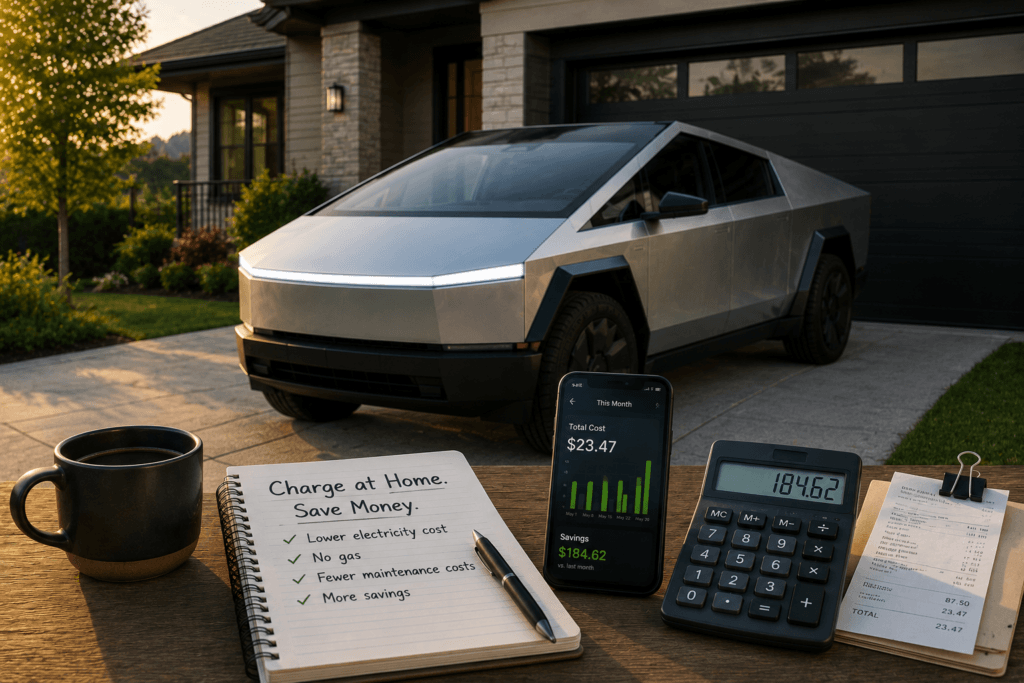
We’ve had commercial service operators come through our doors who were spending upwards of $15,000 per month on fuel — running gas trucks around Victoria and the lower island, covering 200 to 300 kilometres a day.
Switch to electric, charge overnight using BC Hydro’s two-tiered rate program (which offers lower rates during off-peak hours), and you can cut that fuel cost by 80 to 90%.
For the average truck owner doing normal driving, the fuel savings alone can more than offset the monthly cost of the vehicle. That’s not a sales pitch — that’s math. You can choose to keep burning fuel, or you can take that same money (or less) and turn it into an asset you own that works for you.
Tax Advantages in BC
Here’s something a lot of people miss. When you trade in your current vehicle at a dealership, you only pay GST and PST on the difference between your trade value and the price of the new truck. That means you get 12% tax savings on the full value of your trade-in.
And if you’re using the truck for business? The federal government currently allows businesses to write off a significant portion — potentially up to 100% — of the cost of an electric commercial vehicle. Check the Revenue Canada website for the current rules, but this is a genuinely meaningful tax advantage that’s simply not available if you stick with internal combustion.
Why Used Electric Trucks Are One of the Best Values Right Now
At the end of the year, when a business looks at its operating costs, fuel and maintenance are line items on a spreadsheet. When those line items drop by 50, 70, even 80% — that’s real money that can go toward hiring, R&D, or other priorities.
Used electric trucks cost less to run. Full stop. That makes them excellent value, and that’s exactly why we’re seeing strong demand in the used EV market right now.
Part Six: Shopping Smart — What to Figure Out Before You Buy
Before you start looking at specific trucks, take 20 minutes and honestly answer these questions:
- How many people need to fit in the vehicle?
- Will you be towing? If so, what’s the heaviest load and the longest trip you’d realistically do?
- How many kilometres do you drive in a typical day?
- Do you have the electrical capacity at home or work to charge overnight?
- Does the truck fit your driveway or garage? (Some of these trucks are big.)
- How long are you planning to keep it? If you’re thinking 10+ years, features like Full Self-Drive software — currently only available on the Cybertruck — might factor into your decision.
Our team can walk through all of this with you and do the math on your specific situation: current fuel costs vs. projected electric costs, trade-in value, monthly payments, lifetime cost of ownership. Whatever numbers matter to you, we can run them.
Julian’s Personal Picks: Which Truck Would He Actually Buy?
Under $60,000 Used Market
The F-150 Lightning is the most accessible option right now. They’ve been in the used market long enough to bring the price down to around $60,000 or less. A solid, practical truck.
Personally? I’d go Cybertruck. And here’s why: every other truck on the market is covered in fragile paint that’s ready to be scratched the moment you look at it sideways. The Cybertruck has no paint. It’s stainless steel. You can hit it with a hammer and not dent it. It’s built for actual truck life.
Used Cybertrucks are now starting to appear in the $80,000 range. That’s more than $60K, yes — but when you factor in what you save on fuel and maintenance over 5 to 10 years, the math starts looking very different.
If Towing Range Is Your Priority
Go with a Chevy Silverado EV or GMC Hummer EV. Both have 200+ kilowatt hour battery packs — that’s an absolutely massive amount of energy storage. These are the ultimate towing machines. The Silverado in particular is now available in the used market around the $90,000 range.
For the Budget-Conscious Family
Honestly? Wait a little. Smaller, lighter, lower-cost electric pickup trucks are coming. These trucks won’t tow 10,000 pounds and go 600 km — but they’ll meet the real-world needs of the vast majority of families who are currently spending $5,000 to $10,000 a year on gas for a truck they rarely load up. A sub-$50,000 practical electric pickup is going to be a genuinely transformative option.
The Bottom Line
The electric truck market on Vancouver Island has never been better. The charging infrastructure is there. The vehicles can tow, haul, run your tools on a job site, and take you from Victoria to Campbell River and back.
If you’re curious whether an electric truck could work for your life, the best thing you can do is come talk to us. We’ll look at what you’re doing with your current truck, run the numbers, and tell you honestly whether making the switch makes sense — and which truck fits your situation best.
Visit us at motorize.ca, or stop by our shop in Sidney. Whether you’re already driving electric or just starting to think about it, we’re here to help you make the smartest decision for your family, your business, and your wallet.


