
Every week, people walk into Motorize in Sidney, BC with the same questions swirling around in their heads.
Is a Tesla actually worth it? What do real owners think after six months? And what about that whole Elon thing?
So I sat down and answered 32 straight questions — no fluff, no spin — about what Tesla buyers are really thinking right now in 2026. What’s driving them in. What’s holding some of them back. And what actually surprises people once they’re living with one of these cars.
Let’s get into it.
Part 1: The Psychology of Buying a Tesla
Why Do People Choose Tesla Over Every Other EV?
So here’s the reality. When someone chooses a Tesla over every other EV on the market today, it usually comes down to three things.
First: ease of charging. Tesla’s Supercharger network is massive, reliable, and fast. You don’t have to wonder if the charger at your local mall is going to work today. It works. For anyone living here on Vancouver Island — where a road trip means long stretches of highway, mountain passes, and the occasional ferry — that kind of confidence is genuinely important.
Second: low cost of ownership. No oil changes. No scheduled maintenance intervals. No guessing. Tesla’s onboard system watches the car and tells you when something needs attention — that means you’re not paying for service you don’t actually need. Over the life of the car, that saves real money.
Third: the buying and driving experience is just simple. The purchase process is clean and straightforward. The interface inside the car is intuitive and genuinely enjoyable to use. You get in, you go, and everything makes sense from day one.
So Why Do Some People Not Buy a Tesla?
Okay. Now this is where it gets interesting.
The top three reasons people decide not to buy a Tesla?
Elon Musk. Elon Musk. And Elon Musk.
I’ll be honest with you — that’s the real answer. And I say it with zero judgment, because the feeling is completely valid. Some people have genuine personal concerns about the brand’s leadership, and that’s a decision I fully respect.
But here’s what I actually see day after day at Motorize: people come in, tell me they love the car but don’t want to support Elon, and then spend an hour in a test drive anyway. Because the car is that good. Some buy. Some don’t. Both choices are fine.
What I will say is this — a lot of how people feel about Tesla right now is shaped by what they’re reading and watching. So it’s worth asking yourself: am I forming my own opinion about this car, or am I borrowing someone else’s?
What Happens After Six Months of Ownership?
Check this out — after six months of owning a Tesla, most customers basically go quiet.
And that is a really good thing.
Here’s why I say that. When customers are unhappy with a car, they come back and they let us know. With Teslas? We don’t hear from them. They’re out living their lives, driving their cars, and enjoying them. They come back eventually — usually when it’s time to trade in for the next one.
That’s not marketing talk. That’s just what we see, consistently, year after year.
Have Buyer Priorities Changed Over the Last Five Years?
Absolutely. And the shift is fascinating.
Five years ago, buying an EV was still a committed lifestyle decision. People came in driven by economics, or environmental values, or because they’d spent months researching EV technology. It was a passionate, considered choice — people were really drawn to it for a specific reason.
Now? Tesla is mainstream. We get customers who simply need a car. They look at a Tesla, they like it, and they buy it. Full stop. We’ve gone from a tough sell to one of the easiest sells we have.
And once people are in the Tesla family, they tend to stay. About 61% of Tesla owners buy another Tesla when it’s time to upgrade. That’s the highest brand loyalty in the EV space — higher than Toyota, higher than Honda. When people trade in at Motorize, we see everything coming through the door: Cadillacs, BMWs, Hondas, Nissans. But once someone has driven a Tesla, the numbers say they’re very likely coming back for another one.

Part 2: Tesla and the Competition
What EV Brand Is Actually Taking Sales Away from Tesla?
Right now? Nobody, really. Tesla is still No. 1.
But the brand I’m watching most closely for the future is BYD — and when they enter the Canadian passenger car market, things are going to get very interesting. They’ll be Tesla’s most serious competition.
For anyone who comes in and says they genuinely won’t buy a Tesla, here’s what we usually recommend instead:
- Polestar 2 — This is my honest No. 2 on the market today. The fit, finish, and component quality on the Polestar is super impressive. It’s an amazing unit, built to last, with incredible durability. If you want something that’ll hold up as well as a Tesla over the long haul, Polestar is your answer.
- Kia EV6 / Hyundai Ioniq 5 — These have made huge strides recently with their 800-volt charging architecture — that means faster charging speeds, which is a really big deal in everyday use. Very good performance. Not quite at the durability level of a Polestar or Tesla, but excellent value.
- Nissan Leaf or Chevy Bolt — Proven, affordable, reliable choices.
Now, what competes most directly with the Model Y — our most popular unit, ideal for families, five seats, tons of cargo space? You’ve got the Ford Mustang Mach-E, the Kia EV6, the Hyundai Kona, and the Volkswagen ID.4 all playing in that crossover SUV space.
But here’s the thing: none of them compete with Full Self-Drive (FSD). And none of them compete with Tesla’s efficiency. Those two areas are still in a category of their own.
Which Tesla Has Changed the Most?
Of all the Tesla models, the Model 3 has seen the most dramatic transformation from where it started to where it is today. The car is genuinely different — better in basically every way.
And for non-Tesla EVs, the Kia and Hyundai products have improved the most in recent years, largely thanks to that upgrade to 800-volt architecture on the EV6 and Ioniq 5. The Rivian R2 is the most exciting new arrival, but it hasn’t been around long enough to really assess the full picture yet.
Part 3: The Used Tesla Market
Is Now a Good Time to Buy a Used Tesla?
Yes. Actually, right now — as of June 2026 — is a really good time.
Used Tesla prices shot up in 2022 and the first part of 2023. That was true across all vehicles, not just EVs. But since then, the market has corrected significantly. New car prices have come down considerably. Interest rates are reasonable. And used Tesla pricing has followed suit. It’s a balanced, healthy market.
The Model Y holds its value the best of any Tesla. High demand, massive popularity with families, five-passenger capacity, generous cargo room — when a vehicle is that desirable, the resale value stays strong.
The Model S and Model X depreciate the most in dollar terms. But that’s actually great news for used buyers. A five-to-seven-year-old Model S that’s dropped significantly in price is still an absolutely spectacular car. As a luxury vehicle it depreciates quite a bit, but that makes it a tremendous deal on the used market.

Should High Mileage Scare You on a Used Tesla?
Don’t let that scare you. Seriously.
We sell Teslas here at Motorize with well over 300,000 km on them — and they still impress people with how they hold together. If you’re used to shopping for a traditional gas vehicle and walking away from anything over 150,000 km, you’ll need to recalibrate your thinking completely.
With proper maintenance, a Tesla Model 3 or Model Y should realistically reach 1,000,000 kilometres. Not necessarily on the original battery pack — but these cars are built to last, and they’re genuinely easy to maintain and rebuild.
So what should you worry about when shopping used?
Tires and suspension — not the battery.
Battery degradation gets all the attention, but it’s honestly the least of your concerns. What we see constantly is worn-out tires, suspension wear, and the occasional seized brake caliper. Nothing dramatic. Get a thorough inspection, check the tires and suspension, and you’ll be in great shape.
Part 4: The Ownership Experience
The One Feature Owners Love That Nobody Talks About Before Buying
Dog Mode.
I’m completely serious. This one feature has kept more people in the Tesla family than you’d expect.
When you leave your car, you can put it in Dog Mode — your dog stays cool or warm depending on the season, the cabin temperature is maintained, and a message on the screen reassures anyone walking by that everything is perfectly fine. No other car does this. If you have a dog and you buy a Tesla, Dog Mode alone might be the reason you never buy anything else.
The Biggest Difference Between Owning a Tesla and Owning a Traditional Car
Convenience. Plain and simple.
Think about what you do every time you get into a traditional car. You find the key. You take the key with you. You unlock the car. You get in. You put the key in. You start it. You put it in gear.
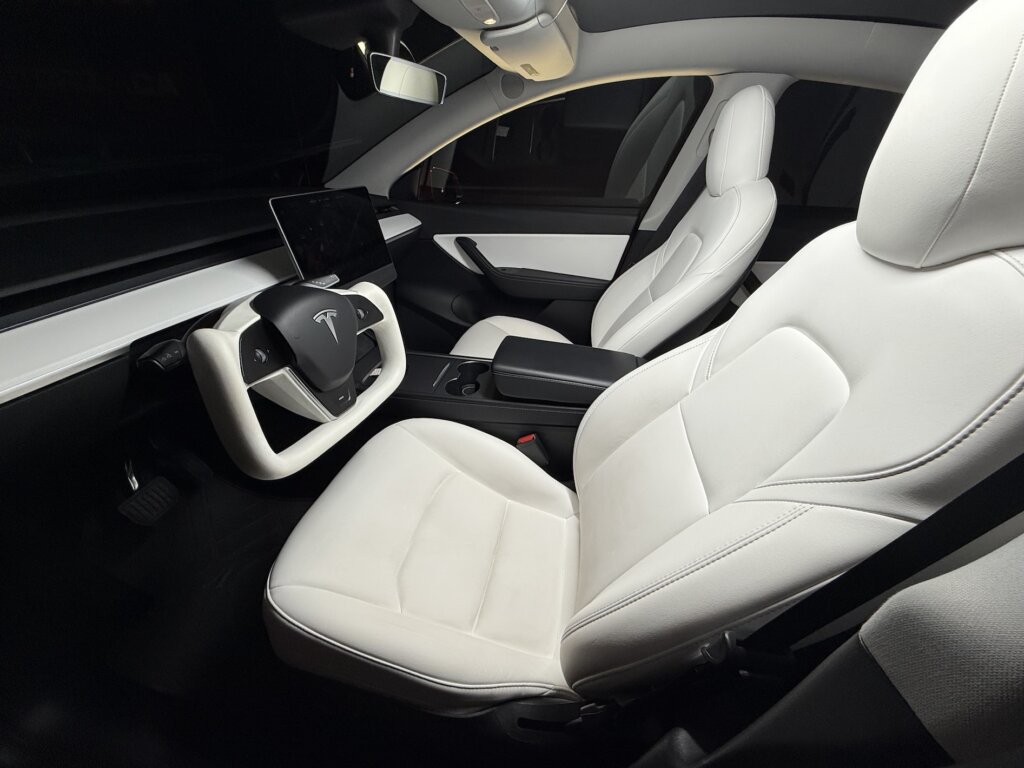
With a Tesla, your phone is the key. You walk up to the car, it recognizes you, you get in, put your foot on the brake, put it in gear, and go. That’s it. No key to find. No FOB to carry. No buttons to push.
Now, some other manufacturers have phone-as-key features on newer models. But there’s still a FOB involved — and if you don’t have it with you, you’re not driving the car. Tesla eliminates that entirely. It’s fewer steps, less friction, and less stress every single day.
What Do Tesla Owners Complain About Most After Purchase?
This one’s actually a little funny.
The most common complaint? Hitting curbs with their wheels.
I get asked regularly if there’s a way to fix a Tesla so it stops hitting curbs. My answer is always two things: No. 1 — use your steering wheel to guide where the wheels go. And No. 2 — use Full Self-Drive, because it’s actually less likely to hit a curb than a human driver.
That’s genuinely the most common complaint. Not range. Not charging. Curbs.
What Maintenance Item Surprises Owners the Most?
The most surprising thing, for most people, is how little there is to worry about.
There are no scheduled service intervals with Tesla. The car watches itself — and when it determines that something needs attention, it notifies you directly. That’s it. You don’t bring it in every six months just in case. You bring it in when it actually needs something.
That saves customers a real amount of money over time, and it genuinely surprises people who are used to the traditional gas vehicle ownership cycle.
Has Tesla’s build quality improved? Yes, dramatically. Tesla took some heat in the early years for fit and finish. That’s largely in the past now. And honestly? Consumers don’t walk around car lots with measuring tools checking panel gaps — they care about how the car performs and how satisfied they are. On both of those measures, Tesla leads the market.
Part 5: Long-Term Ownership and Future Planning
Which Tesla Should You Trust for the Long Haul?
For long-term ownership, I’d recommend looking for cars with Hardware 3 or newer. These are extremely capable vehicles — I’d confidently expect them to perform well for 20 years into the future. Hardware 2.5 cars can actually be retrofitted to Hardware 3, which is worth knowing if you find a great deal on an older unit.
The One Tesla Opinion Most People Would Disagree With
Here’s one that surprises a lot of people.
Most consumers believe Teslas are expensive. They’re actually the lowest cost option on the market — new and used — when you compare option-for-option against other vehicles.
A base Model Y at around $50,000 is, in my honest opinion, the equivalent of a $100,000+ car from any other manufacturer. If another automaker tried to build what Tesla builds at that price point, they’d lose money on every single unit — and many of them actually do.
And the same applies to maintenance. Teslas are the cheapest vehicles to maintain, by a country mile. People assume they’re expensive to run. The opposite is true.
Part 6: Where the Market Is Heading
What’s the Trend Most People Haven’t Noticed Yet?
Full Self-Drive — and it’s moving faster than most people realize.
FSD has been available for years, but a huge number of people still have no idea what it actually does. The moment someone experiences it for the first time on a test drive, something clicks. We watch it happen regularly here at Motorize. People go quiet. They can’t quite believe what they’re seeing. And a lot of those people drive off in a Tesla.
The usership of FSD has gone through the roof. It’s not a future technology anymore. It’s here, it works, and it’s getting better constantly.
What Would Happen If Tesla Disappeared Tomorrow?
Honestly? Nothing else is positioned to fill that gap right now.
Volkswagen would probably make the strongest showing — the ID series is genuinely popular in Europe and Asia, though it hasn’t really taken hold in North America yet. BYD would be right behind them.
But here’s the deeper issue: most other EV manufacturers are losing money on every electric vehicle they sell. That means none of them have a strong incentive to scale up volume quickly. Tesla’s ability to produce high quantities at low cost — and keep cutting prices — has actually forced the entire EV industry to move faster than it otherwise would have.
If Tesla vanished today, I think hybrids would gain more popularity in the short term. But no other EV manufacturer would pick up the slack, because none of them actually want to sell at high volume right now.
Tesla’s push toward low-cost, high-volume production has accelerated the world’s shift to sustainable energy more than anything else in the industry. That’s not a small thing.
The Bottom Line: Should You Buy a Tesla?
So — here’s where we land.
If you want the easiest charging experience, the lowest cost of ownership, the most intuitive interface, the best long-term durability, and a car that will genuinely surprise you with how much you enjoy it? Yes. Absolutely yes. You need to drive one.
If you have real personal concerns about the brand’s leadership and you’re not buying a Tesla regardless of how good the car is? I respect that completely. The Polestar 2 is an incredible vehicle. The Kia and Hyundai products are very good. Come talk to us — we’ll find you the right fit.
Either way, we’re here at Motorize in Sidney, BC, and we’d love to help you figure it out. Give us a call, come visit us, and whether you end up in a Tesla or something else entirely — we’ll make sure you leave with a car you’re absolutely thrilled about.
Because that’s what this is supposed to feel like.


